Wednesday, August 26, 2015

Forest birding at its finest

The hummingbird garden at Pacha Quindi Nature Refuge is a truly marvelous spot for observing and photographing hummers. There are simply endless options for getting the best photographs possible, given the time of course! After filling my camera’s memory cards with countless blurry hummingbird photos, I turned my full attention to the other bird life in the garden and beyond. From the garden there are stunning views of the surrounding cloud forest and the Tandayapa Valley. It is one of those views that leaves you yearning to explore more. Especially when there is a Crimson-rumped Toucanet blocking some of the view! And if that’s not enough, just looking up into the sky when the sun’s out one has a fair chance of spotting a soaring Black–and-chestnut Eagle or a flock of Spot-fronted Swifts. I saw swifts, but never got to identify them, but Tony assured me that Spot-fronted’s were regular. From the garden it is also possible to hear the call of a White-faced Nunbird, a speciality for the area. Its even been recorded in the garden on occasion, but I was not going to get that lucky just yet.    

A Crimson-rumped Toucanet in the garden at Pacha Quindi Nature Refuge.

White-winged Brush-finch is another common garden bird!

View over the Tandayapa Valley from Pacha Quindi Nature Refuge.

It turns out Pacha Quindi has a rather well-designed system of forest trails. The best part is that the trails follow the contours for most of the way, making it easy to focus on birding rather than watching your next step! A walk with Tony on the forest trails delivered a few new species for me. The first bird was just around the corner from the garden and at the start of one of the forest trails. Pretending to be the extention of the dead branch it was perched on, sat a Common Potoo. Tony pointed it out to me but it did no good – it took a while before I was able to see what he was pointing at! While it may look like a branch by day, this nocturnal species sallies for prey from the same vantage points at night. See if you can spot it in the photo below (I am sure you will!).

A Common Potoo pretending to be a branch.

Further into the forest, a splendid Golden-headed Quetzal showed itself briefly. Larger than their trogon relatives, quetzals are striking birds indeed, with iridescent green upperparts and contrasting bright red bellies. Still further on, we had Crimson-mantled Woodpecker, Beryl-spangled Tanager and Flavescent Flycatcher. Among these common species, Tony picked up on the thrush-like call of an Andean Solitaire. Hearing it is easy and pleasant on the ear, but seeing it is another story. Needless to say, I did not see it! But the best was yet to come… It was on our return that we saw it. 

The dim light obscured the details as it stood motionless in the path; it knew it had been seen. It stood still only for a few seconds, before it bounded down the path and around the next corner, and out of sight. Scurrying towards the next bend in the trail as stealthy as I could on quivering legs, I hoped the bird would show again, just for a few seconds more. Heart pounding, I could hear myself breathe – living in the moment, but with a deep desire! I had just seen my first Giant Antpitta! It pulled another enormous earthworm from the ground, before it flew off the path and out of sight for good. What a bird! And what a memory! I can see why birders fall for antpittas, they are perhaps the most enigmatic birds of the forest. Often heard, rarely seen, and what a sight to behold! The size of the Giant Antpitta in particular, is impressive.

Further exploration of the trails over the next couple days produced Sickle-winged Guan, Golden Tanager, Strong-billed Woodcreeper, Golden-crowned Flycatcher, Uniform Antwren, and Green-and-black Fruiteater, amongst others. I had not yet had enough when it was time to leave, but then I was sure I would be back… And so I headed on towards my original destination on the ridge, Bellavista Cloud Forest Reserve. It was only two kilometres further by road, along a steeply-ascending gravel track that snaked its way through endless forest.  

The entrance to Bellavista. A good place to bird in the early mornings!
 
The view of the Tandayapa Valley from Bellavista Cloud Forest Reserve.

Staying at the lodge in the reserve was out of my budget, but fortunately not the camping. It was a better spot anyway, perched above the main lodge with more extensive views of the valley below and additional solitude! The birding was good too. First thing in the mornings, just before sunrise, I would stroll the area between the entrance and the reception area, where the early bird catches the worm. During the night the pathway lights would attract insects, which in turn would draw the birds at dawn. Grey-breasted Wood-wren, Turquoise Jay, Azara’s Spinetail, Russet-crowned Warbler, Rufous-collared Sparrow, Blue-winged Mountain-tanager, and Great Thrush all flitted about in search of any bugs that had not yet taken cover. 

Camping at Bellavista. I had it all to myself!

The restaurant dome at Bellavista. Good birding all around it.

Walking further around the lodge buildings, there would be other birds to marvel at at close-range, including Masked Trogon, Montane Treecreeper, Streaked Tuftedcheek, Red-billed Parrot, Three-striped Warbler, Cinnamon Flycatcher, Brown-capped Vireo, White-tailed Tyrannulet, Capped Conebill, and Chestnut-capped Brush-finch, to name a few. There was no shortage of tanagers, which preferred foraging in the canopies of the tallest trees. I had neck-wrenching views of Flame-faced, Golden-naped, Black-capped, and Golden, amongst some others I’m sure. Occasionally I was lucky to spot the local Chestnut-crowned Antpitta, even hopping on the road leading to the lodge! Its one of the more venturous antpitta species, but easily spooked back into the forest if it knows its been detected by a dribbling birder.  

Masked Trogon can be easily seen around the lodge at Bellavista.

The true bird prizes I was after showed well, and turned out to be rather common, namely Toucan Barbet and Plate-billed Mountain-toucan. I had good views of these in the mornings and occasionally during the day, but few good photographic opportunities. There would always be another time, I kept telling myself!  

Between walking the lodge grounds, the trails and along the main road, it was aways a pleasure to take a break right in front of the hummingbird feeders. While not as impressive as at Pacha Quindi, there was still a couple of interesting hummingbird species buzzing about. While Buff-tailed Coronet was the most abundant, two new species were present which I had not seen anywhere else – Gorgeted Sunangel and the diminutive White-bellied Woodstar.

Plate-billed Mountain-toucan, a much sought-after species, easily seen at Bellavista.

And the same goes for the Toucan Barbet.

Typical foggy moods around Bellavista.

More of the same fog.

The area around my campsite was also productive, and delivered a few more lifers for me, including Stripped Treehunter, Plain-tailed Wren, and an all-dark Collared Forest-falcon. Walks along the road towards Mindo (more on that one later), would ensure Rufous Spinetail, Plushcap, Yellow-bellied Chat-tyrant, Hooded Mountain-tanager and best of all, Tanager Finch. A pair of these striking rufous and black birds was foraging within the roadside bracken, appearing and disappearing at intervals as they hopped through the undergrowth. They eventually disappeared for good, and I was not able to relocate them. But I was still very pleased with the views, albeit without a photographic record.

A mammal highlight at Bellavista came in the form of a newly described species, the strictly arboreal Olinguito. At just before 7 pm, an individual could be seen at the banana feeding station at the lodge. Shy and unobtrusive, you could be forgiven for missing it during its brief visit to snatch a banana and disappear beyond the reach of the spot-light. You could also be forgiven for confusing it with the more common Kinkajou, another arboreal mammal, but with a prehensile tail. These were not the only mammals to visit the bananas, there was also a Tayra. This weasel-like species made a nice appearance one morning with frequent visits to sample one banana at a time. So besides the good birds, I also bagged three mammals lifers in one go! 

The Tayra crossing a branch; please don't ask why I did not use the telephoto lens!

I was still seeing new birds daily when I packed up camp for the next birding destination. I was leaving one great birding spot for another, so no tears shed! It was also downhill from Bellavista, making the departure a whole lot easier.

Thursday, August 13, 2015

Something about hummingbirds

I left Quito rather late, but then just in time to make it to a small town called Nono. The sun had already set when I pulled up to what seemed to be the only store in sight, opposite a small police station. I had just come to a halt when two people approached to greet me. They were Franco and Nico, two Argentinian touring cyclists who had arrived a few hours earlier, and were just chilling outside the local grocery store. We had lots to talk about, and one of the first things that surfaced was where to find a resting place for the night. Over there, in the little house, came the reply. They had permission from a police officer to set up camp inside an old disused information centre. There seemed to be no other option, so I was happy to take a look. The only way in was through the window! There was no place to hang a hammock in the rundown building, while most of the floor space was already consumed by the large tent they had pitched inside it. No problem, if you can’t beat them, join them! And so I was invited to share the tent for the night. That night it rained, and so did the roof. Franco moved quickly to get the flysheet over the tent, which saved us from the worst that the downpour had to offer.   

With Nico and Franco before our departure from Nono, in front of the info centre.

The way to Tandayapa, nicely sign-posted on the way out from Nono.

We did not escape the water invasion altogether, so the next morning a few items had to be hung from the neighbouring volleyball net to dry in the sun. While things dried, Franco and Nico prepared a tasty breakfast soup with pasta and veggies. After breakfast we were ready to leave; they were heading for Quito while I was treading into birder’s paradise. I took the downhill through a spectacular valley that would take me to my first birding site, Tandayapa. Along the way I spotted a number of firsts, such as Cinereous Conebill, Collared Inca (an obvious hummingbird), White-winged Brush-finch, Spectacled Whitestart, Rufous-naped Brush-finch, and best of all, a small flock of Red-crested Cotinga. Lower down into the valley there would be Smoke-coloured Pewee, Golden-bellied Grosbeak, Turquoise Jay, Russet-crowned Warbler, and my first glimpse of an Andean Cock-of-the-Rock lek. Male birds seemed to be plentiful; I had seen them flying towards the lek while approaching from a distance, one bird, two birds, three, four and so on. Though I could never get a glimpse of the actual lek, male birds where regularly flying back and forth, with their shrill calls echoing across the valley. 

Not much to see but fog at this lookout - bad timing!
 
Heading down the valley towards Tandayapa.

Another view down the valley.

I continued down along the length of the valley until it intercepted the Tandayapa Valley. Here I stopped at a small bridge over a stream to see if I would get lucky with a White-capped Dipper. Nothing doing. So I turned towards Nanegalito, where I would get additional supplies to prolong my stay in the Tandayapa Valley. Lemon-rumped Tanager and Golden-crowned Flycatcher showed well, both common birds that I was only seeing now for the first time. Before reaching Nanegalito, I stopped over at a guest house called Alambi for a totally new experience. Despite having spent several months in Latin America, I had not yet visited a hummingbird garden, let alone laid my eyes on a hummingbird feeder. This was my first opportunity to see hummingbirds drawn to a garden, and was surely not going to miss it. What I saw left me buzzing for a quite a while – the sound of dozens of hovering hummingbirds filled the small garden, darting back and forth between feeders, even flying right at me to see if I had something to offer. It was a sight to behold!

The village of Tandayapa consists of perhaps ten houses, here you can see three!

Hummingbird feeders getting a refill at Alambi.
 
An Andean Emerald, a rather common hummingbird species.

A Green-crowned Woodnymph, another fairly abundant species.

While ticking off hummingbirds attracted to feeders is perhaps not the most magical way to see lifers, it is still a magical experience being surrounded by these flying jewels. And I did tick them off, many. The most abundant species included Andean Emerald, White-necked Jacobin, Green-fronted Brilliant, Purple-throated Woodstar, Green-crowned Woodnymph, Rufous-tailed Hummingbird, and Booted Rackettail. Species that required a little more searching effort amongst the dozens of birds were Brown Violetear, White-whiskered Hermit, and the diminutive Western Emerald. Tawny-bellied Hermit was perhaps the rarest, only making a fleeting appearance once in a while. With the additional Silver-throated Tanager, Ornate Flycatcher, Red-faced Spinetail, Tricolored Brush-finch and Ecuadorian Thrush, I walked away with seventeen lifers. 

The White-necked Jacobin is unmistakable with its white belly and neck.

After stocking up with food supplies in Nanegalito, I was heading back to Tandayapa to take on the ascent to Bellavista. Bellavista, which means ‘beautiful view’, is a lodge perched near the top of a ridge overlooking the cloud forest of the Tandayapa Valley. It’s a breath-taking view indeed, especially at sunrise and sunset when the angled rays of the sun set the tree tops along the ridges on fire, while casting gloomy shadows in the lowest parts of the valley. It is a mystical and beautiful scene. I could not help but be reminded of the views from Panoenthung camp in the Kaeng Krachan National Park, southwestern Thailand.

A Red-tailed Squirrel feasting on plantain put out for the birds.

On the way up to Bellavista, I searched for a campsite beside the road to make a dusk and dawn visit to a nearby quarry. The quarry is reputed to host a male Lyre-tailed Nightjar that shows itself rather well in the twilight hours. To be brief, I missed it. But not to worry, there were some other sites known to be frequented by the species, so I would have a second chance. After the sunrise it turned out to be a rather unusually sunny day, with the temperature rising as I ascended the contours. The intense sun made for poor birding, and so with the birds taking shelter from the rays, I was left to plod along breaking into a sweat. I had hoped for a lengthy bird list for the morning but it was not to be. As someone told me, birding in the Neotropics is either a feast or famine – everything or nothing! By midday I had a turn of events. According to my birding map, I had reached the owners residence of Pacha Quindi Nature Refuge, also known as Tony’s hummingbird garden. Tony and Barbara are the owners of this refuge, and have achieved miraculous results in rehabilitating patches of cleared forest. It has taken them years to restore 30 hectares of denuded pastures to their former glory. This was clearly the work of dedicated conservationists, and so I was happy to stay a while and see what else they had been up to.

A Russet-crowned Warbler, a very common but attractive forest warbler.

But first, back to the hummingbirds! With twenty hummingbird feeders rigged in the garden, there was a lot to see. Feeders were well-spaced, with some in the open, some hanging from branches, and others tucked away inside garden scrub. The species assemblage was somewhat different here than lower down the valley at Alambi, but with some overlap of species. The most abundant were Buff-tailed Coronet and Speckled Hummingbird, both new to me, as well as Andean Emerald and Purple-throated Woodstar. A host of other species were also about, including Purple-bibbed Whitetip, Fawn-breasted Brilliant, Green Violetear, Brown Inca, Violet-tailed Sylph, Wedge-billed Hummingbird and White-tailed Hillstar. All were lifers for me. The latter was surely only one bird, as it would visit the same feeder at regular but precisely timed intervals. I spent several hours here photographing, and still had not had enough by the time the sun started to settle. Seriously intrigued, I decided that I had to stay a little longer to explore the rest of Pacha Quindi. It would turn out that the refuge has a splendid network of walking trails through secondary and mature forest. I just had to take a walk to go see for myself… 

A male Booted Rackettail, with it characteristic club-ended tail-streamers.

The female Booted Rackettail has less to show off.

The buff-tailed Coronet has buff on the tail and underwings. Sexes are alike.

While it may be drabber than others, the Brown Inca is impressive!

The Fawn-breasted Brilliant, one of the larger species.

The male Purple-bibbed Whitetip showing the white-ended tail feathers.

The male Violet-tailed Sylph has a splendid tail!

Female Violet-tailed Sylphs are the most attractive female hummingbirds I've seen.

A Green Violetear, often heard throughout the forest but rather shy at feeders.

Notes for birders:

As mentioned in the previous post, the best source for details on birding sites in Ecuador, that I could find, is at Where to find birds in Ecuador (Chapter 2). The maps are hand-drawn but accurate enough that you should have no trouble in finding the sites mentioned, such as the Cock-of-the-rock lek site, the Tandayapa bridge, and the nightjar quarry etc. I printed out the maps of the sites I was interested in visiting, together with a condensed version of the text, and found this adequate for getting around.  Go for it!

Friday, July 31, 2015

How to get to Quito

Nothing seemed too different when I crossed the border from Colombia to Ecuador. It was still green hills everywhere. Before long I reached Tulcán, the first major city on the main road to Quito. A well-attended local festival was in full swing, with the main event being one parade followed by another down the main street. I never got to figure out what the celebrations were about, thanks to my perfectly incoherent Spanish. I at least did manage to get directions to the nearest bank! Ecuador uses US Dollars as its currency (it replaced the Sucre), so the biggest change for me was adjusting to the new exchange rate. I'd been stuck on Colombian Pesos for six months, where 2500 Pesos were the equivalent of one Dollar. It took a couple days for it to sink in…

The green rolling hills of northern Ecuador, as seen from Road 35.
 
One of a number of figures at a roundabout, Tulcan.

After escaping the crowded streets I pushed on. In San Gabriel I managed to find what seemed to be the town’s only hotel, to enjoy my first night in Ecuador in luxury. Finding a wild camping spot seemed like a challenge in the rather open countryside, a challenge I was too lazy to take on. There would always be another day for camping! 

The view from the hotel in San Gabriel.

A mammoth beside my bike! Paleontological museum, Bolivar.

After my birdingless rush through southern Colombia, I had not got around to flipping on my birding switch in Ecuador. I knew there were a few nice sites along the way to Quito, but most of them were off the main route. I again did not have the time to spend wandering about too much, so chose to stay on the beaten track, Road 35. 

On the second day the road dropped down into a massive river valley, accompanied by a complete change in scenery. The lush pastures gave way to a drier scrub-like habitat, very reminiscent of the Little Karoo in South Africa. I almost felt at home! Despite the long wait at the roadworks, I thoroughly enjoined this part of the route. Just when I though it might last, I was back in the green rolling hills. And with that my homesickness subsided. My mind was also occupied with thoughts of finding a place to spend the night, sometimes the greatest challenge facing a touring cyclist. It was well after sunset when I eventually found a hard-earned camping spot beside a sugar cane field. It’s a rather huge relief to find two solid and well-spaced trees that can accommodate a simple device such as a hammock.

View from the top of the massive river valley.

The bottom of the valley. Note the more arid terrain of the mountains.

Some elegant wall art along the way.
 
A great day for cycling! Getting closer to Ibarra.
 
The next day held the promise of some birding. I was heading for the city of Ibarra, but would encounter an Andean lake called Laguna Yahuarcocha on the outskirts. I had also got wind about an official camping site overlooking the lake, so what more could I ask for? A few new bird species to add to the list and a warm shower! A pair of Harris’s Hawk circled above me, with their obviously rufous underwing coverts, followed by a male Ash-breasted Sierra-finch. The lake held the usual waterbirds such as Great Egret, Black-crowned Night-heron, Pied-billed Grebe, Blue-winged Teal, Andean Duck, and Neotropical Cormorant. Some more firsts for me were Andean Coot, Yellow-billed Pintail and a solitary Andean Gull. An Osprey was also seen making its way across the lake. Strikingly beautiful male Vermilion Flycatchers were rather common along the lake's shores, even perching in the reedbeds. Spotted Sandpipers were also about on the edges of the reeds, while I hoped in vane for a glimpse of an Ecuadorian Rail, known to inhabit the reedbeds at this lake. My hopes of seeing a Subtropical Doradito were also dashed. 

The tranquil scene at Laguna Yahuarcocha upon arrival.
  
Not the herons I was hoping for, but then I did see the real thing too.

It turns out this lake has a dark past. Yahuarcocha translates to ‘blood lake’ in the Quechuan language, owing to the colour of the water after the domineering Inca’s massacred the indigenous Cayambe people there in the 15th Century. I’ll skip the rest of the details.

These days the lake presents an exquisitely peaceful scene; locals relaxing about the shores, some fishing the shallows, cyclists and joggers taking to the circumnavigating road. I took this road as well, from which to spot birds instead. Towards the back end is where I found ‘Finca Sommerwind’, the camping ground that I had been tipped off about. Perfect spot for a camp site, with the mountain slope rising up directly behind it. The German owners were very welcoming and I was soon meeting up with the other travelers, also German. A dinner party was arranged for the second night, so I opted to stay longer and brush up on the language again. 

Fishermen at Laguna Yahuarcocha. Camping was at the opposite end of the lake.

The reception and restaurant all in one at Finca Sommerwind.
  
Preparing for dinner at Finca Sommerwind.

View over the city of Ibarra, northern Ecuador.

The lake did not reveal any new species for me the next day, but the splendid scenery made up for the lack of additional lifers. Satisfied, I was on the road again to close the gap with Quito. South of Cayambe I made a stop at Quitsato, the sun dial on the equator. This is the middle of the earth and so I enjoyed the novelty of moving from the Northern to Southern Hemisphere in just a single step. Could anything be more entertaining? Probably. I spent well over an hour here, taking a break from the cycling and enjoying the sunshine.

I could not resist a photo of these intensely blue-coloured dolphins in Ibarra.

Water melons for sale, and grilled corn.
 
Satisfy your soul; what else needs to be said?
 
My second night of wild camping in Ecuador.
 
Well hello! A cicada that took shelter under my shirt for the night.

Sign post at the Equator - the middle of the world.

Information board at the Quitsato sun dial.

Yep, all zeros for the latitude reading - this must be the Equator!

A weary traveler at the Equator, beside his vintage and trusted bike!

Freedom of the open road! Heading south from Cayambe.

I then made the most fabulous discovery yet since arriving in Ecuador. Well, I did not discover it myself actually, but was again tipped off. But the thing is, it took me a while to find it so in the end it felt like a self-made discovery. And that is the El Chaquiñán cycle route, an old disused railway line between Quito and Ibarra to the north. And I am not the first to say that it is a wonderful discovery, you can read a more detailed review by 'Crazy Guy on a Bike'. He also had fun along this route, but luckily for him, he rode all 70 km of it, from Cumbaya (close to Quito) to Cayambe (it possibly goes still further north). 

 
Map of the El Chaquiñán cycle route, from Puembo to Cumbaya near Quito.

There are numerous such portals along the route, with a security guard!

I heard about it only upon my arrival in Yaruqui, which is close to the Puembo portal (see the photographed map above). I had to use Google Maps and a little luck to actually find the portal to access the route here. Apparently the majority of the route from Puembo northwards to Cayambe is not in the best shape (and also not sign posted), so a mountain bike would be the recommended mode of transport for this section. However, the 18 km or so from the Puembo portal (coordinates: -0.179925,-78.360334) to the Cumbaya portal (-0.199545,-78.431482) is well maintained and I am pleased I had the chance to ride it. Highly recommended! Firstly, it was previously a railway line so it follows the contours making for easy riding, and secondly, it passes through the spectacular Chiche River valley. So don’t miss out on this one if you are heading for Quito by bike! Take note that once you reach the Cumbaya portal and exit the cycle route, you are on your own finding the way into Quito city. I took the most direct route via a suburb called Guapulo; it was most likely the shortest, and probably the steepest!

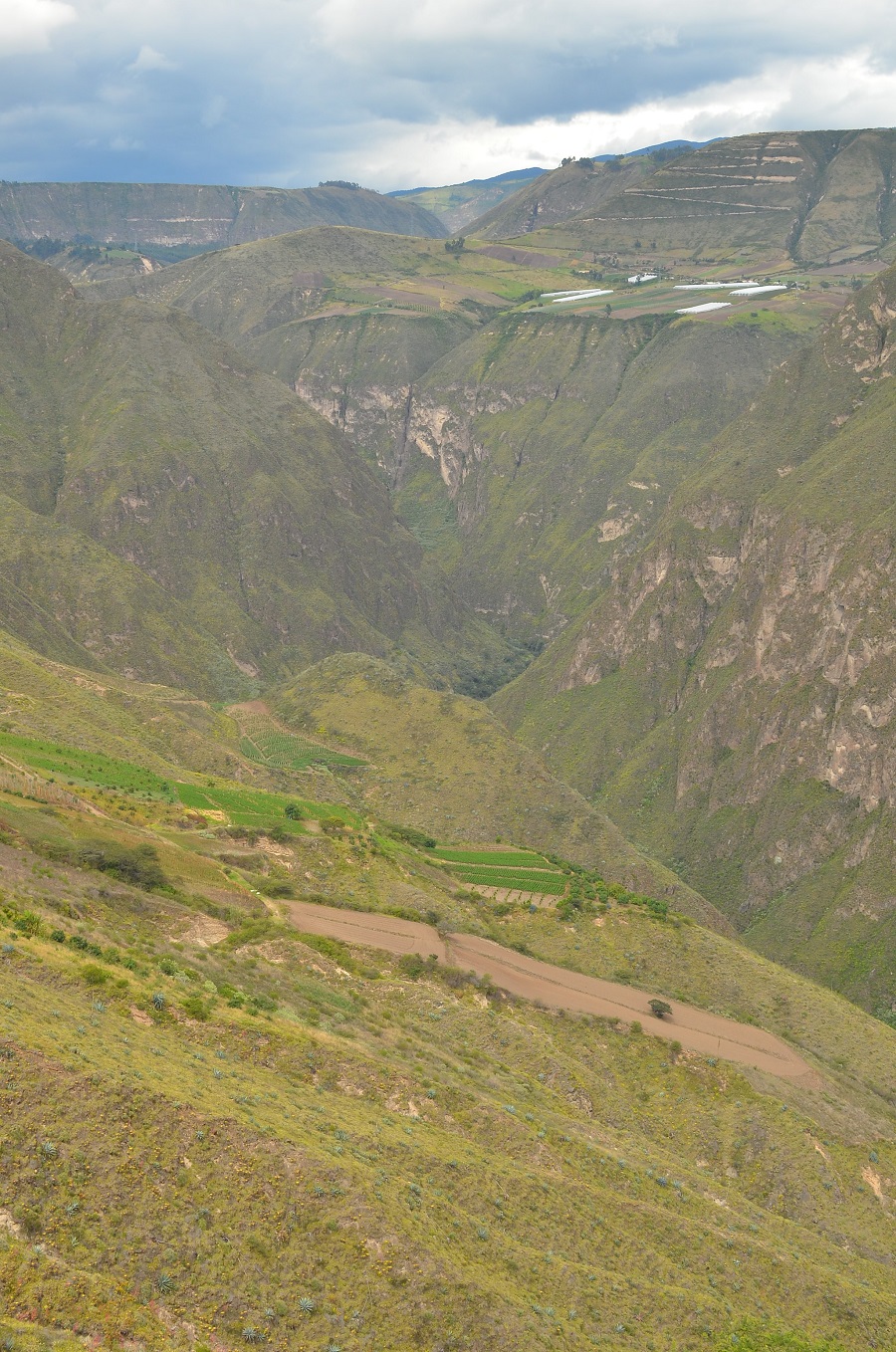
View over the Chiche River valley from the cycle route.

Entrance to a long and dark tunnel.

Looking back through the tunnel. Note the nearly buried railway line.

And there was light at the end of the tunnel!
 
A few smaller tunnels and 15 km left to go to Cumbaya.

Looking back across the valley to the tunnel entrance, marked with an arrow.

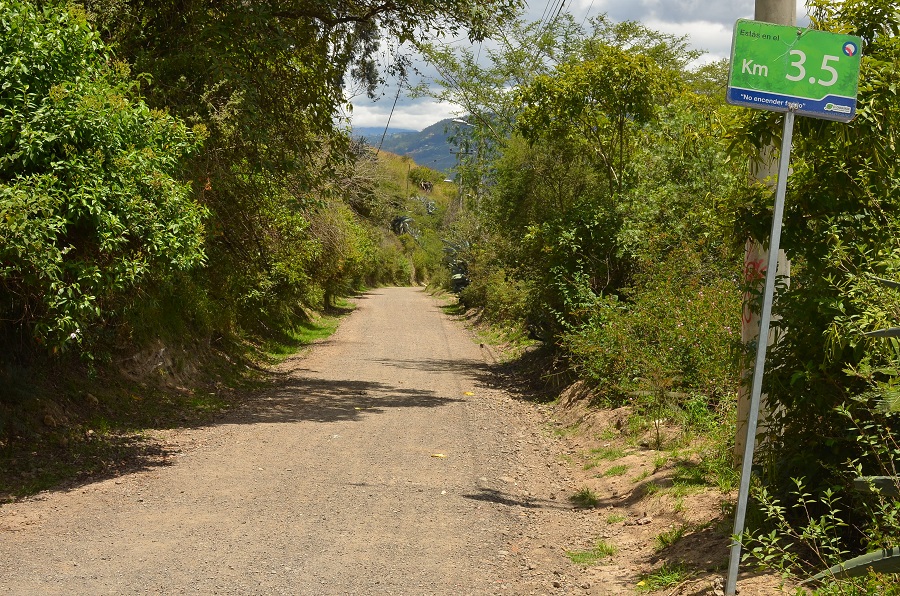
Almost there, just 3.5 km to the Cumbaya portal.


At the Cumbaya portal after a fantastic ride.

Once in Quito, I made plans for the next trip, and also the last…My apologies for passing on no earlier warning, but my plan for cycling much further through Latin America has taken a u-turn. Quito would be the last capital I would visit after three years on a bike. There are a number of reasons for bringing this trip to a closure, and I figured it would be better to do this sooner than later. Although this blog’s days are numbered, I do have another scheme, so do come back. See you at the next post, I promise to have a bird picture or two! Thanks!

Ecuador is a land of volcanoes.

The streets of Quito, Ecuador's capital.
 
And another view.

Looking south across Quito.

Quito getting ready for the night.

The touristic centre of Quito, with hostels and hotels around every corner.


Notes for birders:

Rather than reinvent the wheel here, I will direct you to perhaps the best sources of information that I could find on birding in Ecuador. There you will find more than enough information about where to go, how to get there and what to see. First off, Where to find birds in Ecuador is a valuable resource for any birding wanting to visit Ecuador. The site is divided up into regions, with maps accompanying most of the best birding sites covered. I relied heavily on this information. Next would be Birding Ecuador, which gives a more personal perspective with numerous trip reports made by the author. It also has a list of links to other birding sites.