Friday, October 5, 2012

Cycling through Lofoten


The coastline of Norway is not a straight line. The innumerable islands and fjords create a complex and stunning mosaic of land and sea. This becomes particularly evident around Tromsø, a city situated on an island, and further southwards. Ferries link the road network in strategic places, making it possible to explore the best of this magnificent coastline. However, timing is of essence if one wants to enjoy the benefits of the ferry route. While staying in Tromsø I learnt that two of the ferries I was planning on taking from Tromsø had closed a week earlier, as these were summer ferries and therefore only open during the vacation period. I had no option but to take the busy E6 highway in order to get to my next destination, Lofoten, a massive peninsula made up of large islands and fjords. 

A typical small town in Lofoten, surrounded by mountains.
 
The three days it took travelling the E6 highway were rather uneventful birding-wise, but at least I reached Bjerkvik in good time. From here I left the E6 and took the E10 which would lead me all the way to the end of Lofoten. From Bjerkvik the road passed through magnificent landscapes with mountains and idyllic lakes. Some of the lakes held species such as Whooper Swans (up to 20 at one lake), Slavonian Grebes, Black-throated Divers, Pintails, Mallards, Teals, Goldeneyes and Tufted Duck. Road tunnels were fairly frequent in places, adding another interesting element to the route. After passing through one particularly long tunnel, I decided to take some time out at a parking space beside the road. Much to my surprise, I was greeted by the sight of a Merlin perched on a nearby pylon. After watching me with interest the small falcon took off only to land a short distance further down the road, providing more excellent views. Though I was not able to photograph this individual, I was able to get another a few days later, perched on a road sign.

An obliging Merlin perched on a road sign.

I saw my first Golden Eagle from a bridge over the Jågsfjorden. The eagle was feeding on a prey item along the shoreline of the fjord, while two White-tailed Eagles were watching from a safe distance. This gave me the impression that Golden Eagles are dominant over the latter, which I subsequently heard from local ornithologists to be the case. A number of Hooded Crows were also in attendance and although they approached quite closely, they did not get a chance to sneak any scraps. I saw a good number of Golden Eagles between the towns of Fiskebøl and Svolvaer, where the mountains were particularly impressive with steep cliffs crowning their tops. Though always seen at a distance either perched on a mountain top or soaring past almost vertical cliff faces, these birds had an unmistakable presence about them. A majestic bird in a majestic environment. 

I made a stop-over at the Viking Museum in Borge, a famous site where the foundations of a Viking longhouse dating back to the period 500 - 950 can be viewed. Original artefacts such as glassware, stone, bone and metal tools and other items found at the site are also on display here, making this a unique museum. Taking the self-guided tour, which included a short film, reminded me of the Big Hole Museum in Kimberley back in South Africa. After visiting the museum’s main centre, I headed down to the shore where a replica of a Viking ship was moored. By this time a fierce storm had reached Borge and I suddenly felt the need to find shelter from the gale and rain. It was already late afternoon and with nowhere to go, I pitched my tent in a dense pine forest close to the Viking ship. The storm lasted for hours, pushing the walls of my tent in all directions. Next morning I woke to a calm and serene atmosphere, as if there never was a storm. The call of a Robin in the woods close to my tent sounded absolutely amazing, almost like it was striking a cord inside me, reminding me of how often we take the simplest things in life for granted.  
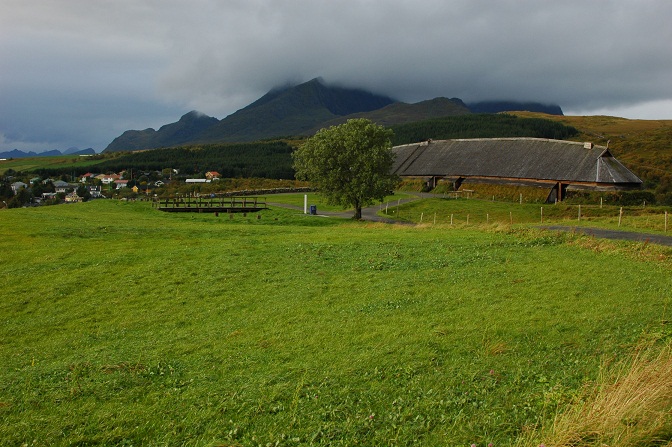
Replica Viking longhouse at Borge, with original foundation to the left of the tree.

The next town I passed was Leknes, where I visited a small but nutrient-rich lake which looked promising even from a distance. Indeed, there were several waterbird species present, including Slavonian Grebe, Grey Heron, Tufted Duck, Goldeneye and Mallard. A small flock of Ruff made a fly-by, and I was reminded of reports from friends back in Kimberley that this shorebird species had already started arriving in South Africa. Close to the lake’s bird hide I heard the alarm call of a Snipe; closer inspection revealed a number of birds hiding in the flooded grassland at the edge of the lake. 

The small but productive lake at Leknes.
 
Cycling further towards the town Ramberg on the northern side of Lofoten I passed some agricultural fields where I was surprised to find my first Lapwing for Norway. A pair of Whimbrels was also enjoying the flooded fields, while Meadow Pipits occasionally flushed from the taller grass. Further on I reached Ytresand in the late afternoon, another recommended birding spot with enormous potential. A small lagoon surrounded by extensive marshland alternating with agricultural fields seemed the perfect environment for shorebirds. Unfortunately my attempt to bird the area well was short-lived when yet another storm moved in for the night. By the morning the wind had subsided but not the rain, allowing only a small window for birding. I did however manage to see a Black-tailed Godwit and Dunlin feeding on some mudflats on the way out.

The marsh at Ytresand.

By now I was close to the end of Lofoten with my final destination being Moskenes. From here I would take the ferry to the Vaerøy, an island some 15 km from the tip of Lofoten. A second ferry ride would get me to the next island called Røst, before catching a third ferry to Bodø back on the mainland. So in order to make my first ferry ride, I pushed on for the ferry town of Moskenes. On the way, I met Derek and Laura at the picturesque town of Reine. Unknown to me at the time, we ended up taking the same three ferry rides from Moskenes to Bodø, and so got to meet up on more than one occasion to share our experiences of this amazing part of Norway. 

The mountains near Reine in Lofoten.

Arriving at Moskenes with ample time before the ferry departure to Vaerøy Island, I made a quick trip to Å, a small town some 5 km from Moskenes. Å is the most southerly town in Lofoten, from where one can see the steep and imposing mountains of Vaerøy. From where I was standing, I could see Cormorants, Shags and Kittiwakes negotiating the light gale blowing from the south. I have been warmer, but rarely quite so content.   

At the end of Lofoten, looking in the direction of Vaerøy.

Wednesday, October 3, 2012

Cycling in the rain


After Alta the next major destination was Tromsø, the largest city in northern Norway. When my brother told me that he would soon be in Sweden for a work-related trip and could meet me in Tromsø for a couple days, I sure wasn’t going to miss the opportunity to see family. With six days to cover the 400 km trip to Tromsø there was not much time to waste, so I was on my bike again after spending a day in Alta. I did manage to visit some of the mudflats in the Altafjord during lowtide, but the low number of shorebirds reminded me again that autumn was in full swing. A few Dunlin were found feeding frantically to fuel up for their southward journey. The quiet waters of the fjord held Grey Herons, Red-throated divers, Red-breasted Mergansers, Common Eiders, Goosanders, Common Shelduck, Greylag Geese and Goldeneyes. Passerines in the woodlands and gardens included Brambling, Redpoll, Willow Warbler, Fieldfares, Magpies, Willow Tit and Greenfinch. I was pleased to see some Blue Tits, as Alta is about as far north as this species has been recorded in Norway. 

The next couple of days did not reveal any additional species of interest but I was happy to enjoy the fantastic scenery of the fjords, with Langfjorden being no exception. There were also a few climbs to get over, the most notable one being Kvænangsfjellet at over 400 m. Occasionally one’s effort at finishing a steep climb is recognised by fellow road users; upon reaching the top a passing motorist gave me a hoot and thumbs-up. 

A view down Langfjorden, north of Alta.

After the descent i got my first Sparrowhawk; which was flying overhead and calling excitedly. There seemed to have been some commotion which may have involved more birds, but I did not see any others. Heading for the town of Storslett I met with some strong headwinds which made steady cycling a challenge, while the next couple of days brought rain, and lots of it. I realised I would need to make adjustments to my gear if I intended to stay dry during such periods. Things don’t dry out overnight and especially not when your only shelter is a tent that is drenched on the outside and barely dry on the inside. In an attempt to keep my feet dry while cycling, i wore plastic bags over my shoes. This would last for a while, but not for a whole day.

Before the climb at Kvænangsfjellet.

Cycling along Kåfjorden I met two Swiss cyclists who were heading north to Nordkapp. They were very happy to see me as i was the first touring cyclist they had encountered since embarking on their trip a week previously. So it was a real moment when within a couple of minutes of chatting beside the road, a group of over ten touring cyclists pasted us! Nothing for days and then everything at once! 

The Swiss cyclists on their way to Nordkapp, also wearing bags over the shoes.

With the constant rain I found myself taking cover at every grocery store along the way in an attempt to lose some moisture. During this time birding was not at the top of my priority list, but rather staying dry. A Sami handicraft shop in Manndalen seemed like an interesting alternative to the grocery stores so I was keen to take a look inside. I must have looked like a cat dragged in from the rain, because the friendly ladies running the shop immediately brought me a cup of tea and some cake. I was then given a tour of the shop by Eda, who also explained the art of making traditional woollen Sami clothing using an ancient weaving technique. Once again, warm hospitality at its best. 

Sunset over the Storfjorden north of Skibotn.

Back in the rain, i made my way to the next town called Skibotn. A break in the clouds allowed a single House Martin a chance to forage along the road, flying back and forth past me as it hawked insects in the air. Arriving in town, i was relieved to hear that my friend Mikko from Tromsø was in Skibotn for the week. He was there together with staff of the University of Tromsø presenting a field course to a group of biology students. Mikko kindly arranged for me to spend the night at the field station, and so I had the opportunity to meet with some fellow biologists. It also gave me the opportunity to dry out a bit!

The road south of Skibotn, heading to Tromsø, with fresh snow on the mountain tops.

It was another two days before I reached Tromsø, just in time to meet up with my brother who had made a significant detour to get so far north in Norway. The two quality days we spent together were too short, but hopefully there would be another chance to meet along the way. After his departure, I had a great stay at Mikko and Anna’s place while I waited for some new gear I ordered to arrive. They treated me to some excellent home-cooked dinners and took me on an unforgettable outing to pick blue berries. The blue berry crumble Anna made with the spoils of this outing was amazing; i will never look at blue berries the same again!

While in Tromsø i spend a day birding the surrounds north of the city, with Black-throated Diver and a single Spotted Redshank being the highlights.

Spotted Redshank north of Tromsø

Thursday, September 27, 2012

Of Lesser White-fronted Geese and more


I spent a cold night in Lakselv, so was looking forward to the day, which promised to be a good one judging by the amount of blue sky I could see from inside the tent. My first stop on the way north from Lakselv was the Stabbursneset headland and Valdakmyra marsh in the Porsanger Fjord, an important staging area for the Lesser White-fronted Goose. I found the usual wetland species at the marsh, such as Mallard, Wigeon, and Greylag Goose, as well as some species still somewhat unfamiliar to me, such as Pintail and Common Shelduck. I also saw my first Grey Herons for the trip. I also made a short trip of a few kilometers to Stabbursdalen valley, where the world's most northerly pine forest occurs. Though the forest was quiet, i did get to see some species close up, such as Siberian Jays, Bramblings and Willow Tits, as well as a pair of Red Squirrels. 

Siberian Jay in the Stabbursdalen valley

Back at the headland at Stabbursneset, which overlooks the southern end of the Porsanger Fjord, i met Tomas and Ingar, both ornithologists who were there to undertake various bird surveys, including a population count of the Lesser White-fronted Goose. This species, which had not yet arrived at the headland and marsh from their breeding grounds, is unfortunately in decline. Tomas mentioned that the number of pairs returning each year to the Porsanger Fjord was decreasing each year; the last counting being shockingly low. What makes it tricky finding out the reasons for the decline, is that no one really knows where these birds spend the winter once they leave the fjord after their short stay. And so it was that I did not get to see the Lesser White-fronted Goose, as I could not afford to wait until their arrival, but I was more concerned about their future survival than adding the species to my life list.

It was great experience chatting to Tomas and Ingar, and learning more about Norwegian bird life and research from such dedicated field ornithologists. To top it all, we were rewarded with great views of a Gyr Falcon flying by, before making a dashing attempt at harassing a flock of Hooded Crows on the marshland. With time running short, I had to leave if I was going to make it too my next destination, the town of Alta. Moving further north along the western side of the fjord i spotted Goosanders, Red-breasted Mergansers, Greylag Geese, Common Eiders and White-tailed Eagle. At some fresh water lakes to the west of the fjord I found my first Slavonian Grebe, in non-breeding plumage. A little further I was pleased to find more grebes, especially since they were still in breeding plumage and feeding their young. I spent quite some time here, when I should have been off cycling! Before I could leave, Tomas and Ingar arrived; they had driven the same route to conduct some surveys. So we spent some more time discussing birds while watching the adult grebes dive for food to feed their hungry offspring.  

Slavonian grebes, sometimes also referred to as Horned Grebes

Later that afternoon at a small town called Olderfjord, I passed the turn-off to Nordkapp, probably the most popular site in Norway for touring cyclists to start or end their journeys. It was nearly a 300 km detour so I resisted the temptation to see what Nordkapp looked like, and continued west to Alta. I passed some areas with rolling hills that were perfect for Rough-legged Buzzards, which were seen regularly when it was not raining! 

Should i go or not? I skipped the chance to visit Nordkapp to save time
 
Great habitat for Rough-legged Buzzards on the road to Alta

After arriving in Alta, I made a beeline for the public library to check emails, so I could make contact with my host, Stig-Martin. I eventually ended up in the Barila Pub across from the library, as the latter had no internet service for the day. I soon realised that my host lived 25 km outside of town, and I would have to take the same road I had just cycled to get to his place! My dismay at this realisation was noticed by an Alta resident who was visiting the pub with her friends. She kindly offered to drive me to Stig’s place, an offer i could not refuse considering that I had already cycled 90 km for the day. After checking again that she was okay making a 40 km plus detour to drop me off, we were loading my bike and panniers into her Toyota Hi-Ace. Once again, i was overwhelmed by the friendliness and helpfulness of the people I have met on this journey. There is a lot of good in this world, if we choose to see it. How we see this world depends on how we choose to see it – choose to see the bright side and the bright side will find you. 

Stig was a great host, who prepared a great ‘cyclist’s dinner’ with rice, egg and sausage scrammed together. His humour was fantastic and I enjoyed his stories about being hungry while touring, something I could easily relate too after being in the saddle for over a month… 

Watch out for these guys in Olderfjord if you plan to visit Nordkapp!

Thursday, September 20, 2012

Finally, heading south


After covering the Varanger Peninsula reasonably well since the start of my journey in July, it was indeed time to head south. My aim was to get to Tromso before the end of August, a distance of approximately 700 km passing the larger towns of Lakselv, Alta and Storslett. My first stopover was at Tana to meet up with my next host Rajan, who, like Arve, was a real inspiration for travelling. Rajan’s down-to-earth approach to life was infectious, and his hospitality without limits; I was treated to traditional Sami reindeer stew, sea trout cooked over coals, and lots of ice-cream. Rajan had a day off from work, so I joined him and his brother for a short fishing stint at the Tana Delta (no bites), before we departed ways. I headed a few kilometers north to set up camp at Kalbaknes, with a spectacular view over the Tana delta and surrounding mountains. My neighbours were two German couples who were touring Norway with their campervans and it was not long before we got acquainted. I was soon served pan-fried fish, bread and a couple of hot drinks to go with the great company. A guitar was later brought forth by one of the gentlemen, who played a few well-known English and German tunes while we watched the vast Tana delta bathed in moonlight. Another memorable moment…

The Tana delta in the late afternoon.

Well before the break of dawn I awoke to an astounding sight. There were literally thousands of Goosanders spread across the main river channels of the delta, riding the outgoing tide. I had never seen so many Goosanders together before, but the birds dispersed rapidly as the waters approached low tide. As the morning progressed, i scanned the mudflats for any exciting birds amongst the masses of Herring and Great Black-backed Gulls, finding the odd White-tailed Eagle perched on a sand bank. Arctic Skuas were also present, flying back and forth on the lookout for easy pickings. An Artic Redpoll made a brief appearance before I headed off to start the day’s cycle. Typical birds seen along the way, usually flushed from the roadside thicket, included Fieldfares, Redwings, Magpies, and Meadow Pipits. Redpolls, Willow and Great Tits were usually picked up by the calls, while the occasional Bluethroat was seen in willow thickets.

The only owl seen on this part of the trip!

The next two days presented some of the hardest cycling I had encountered yet. The 100 km stretch from Kalbaknes to Kunes via Iford had numerous climbs, some taking over an hour to defeat. But  the steep ascends usually meant that cliffs would not be far away, so it was not long before I was rewarded with good views of a flying Gyr Falcon. A Black Guillemot at one of the fjords was also a nice find, as I had not seen this species since late July at Vardø. Just outside the town of Iford I had great views of my first male Willow Grouse beside the road, but the close encounter made it hard to get the camera out without flushing the bird. Instead, I have a photo of a Hooded Crow, a species seen daily in Norway! 

Its signs like this that gave me the shivers, not the weather.

Hooded Crow, a common species seen daily.

I arrived at Kunes the next morning hoping to catch the grocery store to get some essentials for the day. Upon arrival, I soon realised that the only store in town was closed. I had lost track of time, it was already Sunday, a day when all stores in Norway are closed. My dismay quickly turn to bright cheerfulness when a town resident living close to the store ask if I needed help, and then invited me to join her and a friend for lunch! I was generously treated to bacon and eggs, and amazingly for this part of the world, freshly picked garden strawberries. This was a great stopover, and I was again grateful for the wonderful hospitality.

The ride from Kunes to my next destination, Lakselv, was an easier ride than what i had passed through before. Small lakes beside the road produced some waterfowl species, such a Wigeon and Common Teal, as well as my first Pintail. The only climb was the stretch to the Silfar Canyon, one of Northern Europe’s largest at a depth of 80 metres. The crystal clear water cutting through dolomite makes this canyon especially impressive. Unfortunately no cliff-loving raptors were to be seen in the vicinity.

A part of the Silfar Canyon.

The downhill ride from Silfar brought me into the Porsanger Fjord, which has the most expansive mudflats anywhere in the Finnmark County of Northern Norway. A stopover at a small lake beside the fjord produced a pair of Whooper Swans with four juveniles, but with the sun nearly set, there was not much time to explore the seemingly productive area any further. I pushed on to get to Lakselv before if got too late.

Thursday, September 6, 2012

A short trip to Grense Jakobselv


After visiting Pasvik I was keen to try out another detour, to Grense Jakobselv, which was highly recommended by a British couple I met earlier on my journey. Grense Jakobselv lies on the Barents Sea and is the northern-most border area between Norway and Russia. It is also listed as a worthwhile birding spot, where good numbers of seabirds can be seen. It was a 60 km trip from Kirkenes so I decided to cycle there and back in two days, to make up time for the impending southward journey through Norway. The scenery during the first half of the trip to Grense Jakobselv was pretty much the same as what I had been used too in these parts of Norway, but it was the second half that blew me away. Passing the Jarfjordfjellet Mountains, where the rock is some of the oldest in Europe, was something to behold. This was followed by the spectacular descent into the valley of the Jakobselv River, which reminded me of the drop from the escarpment into the Lowveld in South Africa (something I have unfortunately not had the opportunity to do often enough).  

A portion of Jarfjordfjellet Mountains, some of the oldest rock in Europe.

It was after the drop into the valley that I met Frank and Lill, who invited me for a cup of tea at Lill’s mother’s house. Sitting outdoors around a fire drinking tea in the company of great people was the perfect way to round off the day’s trip. It turned out my new Norwegian friends were old friends of Ronny in Kiberg; what an amazing world! After saying our farewells, i was on my bike again to complete the last few easy kilometers to the mouth of the Jakobselv River. The river with its stretches of sand banks and lush riparian woodland kept reminding me of South Africa. Was I homesick already? Never! Or not just yet. I think i experienced an epiphany during this part of the trip, coming to the full realisation that everything is one, everything is connected somehow, and like i have read somewhere before, 'all is everything, everything is one'. So no matter where we find ourselves in this world, our planet is still one organism, and all life is a continuum. 

The Jakobselv River.

The birds were quiet as it was already early evening, but it was not long before i reached the sea. With still enough good evening light, i did some scouting for shorebirds and others at the river mouth and beach, picking up the usuals such as Oystercatcher, Common Eider, Herring and Great Black-backed Gull, Goosander and Red-breasted Merganser. A small flock of Red Knots in non-breeding plumage amongst a rocky patch along the beach was an exciting find. Next morning revealed numerous Cormorants, Shags, Kittiwakes and Arctic Skuas flying back and forth just offshore. The latter were harassing the Kittiwakes as usual. Some Black-throated Divers were also not too far off. 

Overlooking the fjord at Grense Jakobselv.

The mudflats at the river mouth lagoon were surprisingly quiet in terms of shorebirds, although there were hundreds of roosting gulls and good numbers of Hooded Crows. I searched the gull flocks for an out-of-range Glaucous Gull, which would stand out like a sore thumb because of its large size, but no luck. Fieldfares and Redpolls occupied the areas with denser shrubs while Meadow Pipits were common in the vegetated dune fields. My lifer for the day was a pair of Willow Tits in the riparian thicket, a species I would see many times in the following weeks.

Looking back at the Jakobselv River valley, with mudflats on the left.

The trip back to Kirkenes was again spectacular, especially with the sun managing to break through the clouds more often than the day before. Along the way I was again pleasantly surprised by the friendliness of the locals. I was stopped by a family, with members of three generations present, and after answering enthusiastic questions relating to my journey, was handed a box of Russian chocolates! Later that evening i met up with my host, Arve. Chatting to people who are passionate about traveling is truly inspirational, and one can learn so much from their ‘out-of-the-box’ life experiences. Unfortunately there was not much time to chat due to Arve’s busy schedule, but I am most grateful for the opportunity to have met him.

Willow Tit

On the way back to Varangerbotn I spent a night close to Neiden, in a last effort to get Little Bunting the next morning. With an early visit to the chapel at Neiden where the buntings had been recorded in the past, I was greeted by a host of other species instead, such as Spotted Flycatcher, Pied Flycatcher, Redpoll, Willow Warbler and my first Bluethroat with a blue throat. It was actually just a small patch of bright blue on an otherwise brown bird. Nonetheless, it was exciting enough to see as all previous individuals I had seen in Pasvik and Kirkenes had no bright colours at all. Moving on west I had good views of a juvenile Cuckoo beside the road, as well as a female Tufted Duck with ducklings. Arriving late at Varangerbotn, I again visited the bird hides in the hope of catching up with Temminck’s Stint, but it seemed that things were no longer the same since my visit two weeks earlier. I got the feeling that the shorebirds, especially the small waders, had perhaps begun their southward migration. Even the mosquitoes seemed to have moved on, as I had no trouble getting a good night’s rest on the bench in the bird hide.

Having reached Varangerbotn, I was now ready to begin the southward journey through Norway. I had visited some great birding sites in the north-east of the country, but it was now time to make progress, or I would get caught by the Norwegian winter.